- 2025 January Perfume-Making Week
- 2023 New Year Sustainable Perfumery Week
-
2026 January Perfume Making Week
- Perfumery for the future: five days of theory and practice working with renewable and biodegradable materials, 26 - 30 January 2026
- £850.00
How to Create Sustainable Fragrances - a Workshop for Using Sustainable, Biodegradable Materials in Perfumery
The future of perfumery is going to be all about exploring upcycled naturals, synthetics, and materials produced through green chemistry. In this five-day perfume making workshop, you’ll learn how to use this new palette to create the scents of the future - and have the chance to ask all your questions about setting up and running an artisan perfumery.
Can’t Make It to the Workshop? Take a look at these options:
If you can’t get to London in-person, there are other ways to learn perfumery with Sarah McCartney.
-
Scenthusiasm Scent School: Sarah’s complete online course covering everything you need to start, from explainer films to 12 scent styles and a recommended materials list.
- Scenthusiasm Community: An online space for fragrance lovers with exclusive perfume formulas, past creations, live Zoom sessions, and a private Facebook group.
Why not get a headstart?
- Date: Monday to Friday, 26–30 January 2026
- Time: 11 a.m. to 5 p.m. UK time
- Where: 4160Tuesdays' studio in Hammersmith
Group size: The group is limited to 8 people so everyone receives personal attention from our perfumer, Sarah McCartney.
Important notes
- Age: This is a class for adults. Our studio is a workspace and is not insured for children to be present. We can accept bookings for ages 15+. Thank you.
- Accessibility: Our classes are in an old building, held in the upstairs studio accessible via a narrow staircase with no handrail. If you need special arrangements, please let us know before you book.
Sarah will be sharing her professional materials, as well as her knowledge.
“Five days of exploring materials and formulas and bringing your own vision to life. The course will give you an excellent foundation for understanding how to make perfume. I found Sarah’s expert guidance invaluable and had the best fun - so much so that I had to come back for a second time.” - Florian
What we'll do:
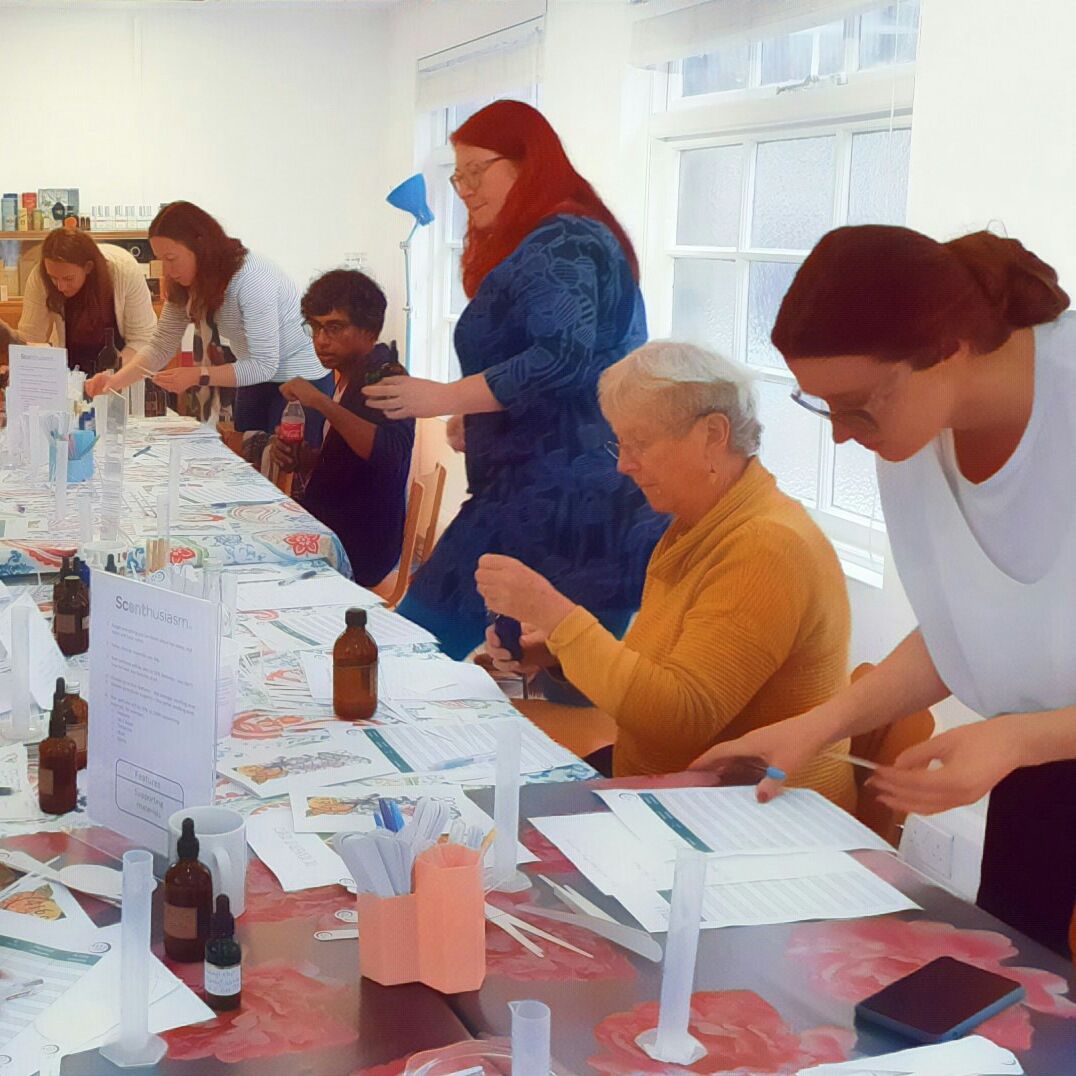
We have five days of practical perfumery, starting each day with smell training and making accords, exploring materials which are used to compose different styles of fragrance, traditional and modern.
You'll also have the opportunity to ask Sarah every question about setting up an artisan perfume brand.
We make fragrances every day; there’s a fragrance formula to compose each day, with options to adapt it or to compose an alternative of your own.
Sustainable Perfumery
The focus is to:
- Make great fragrances
- Explore and use sustainable, biodegradable materials in perfumery
- Formulate fragrances with new, greener alternatives
- Plan for the 2030 environmental regulation changes
- Examine wider ethical issues in fragrance making
"The course is BRILLIANT, there is a lot to learn and Sarah has compiled this in depth information through years of experience and hard work and is generously sharing it with us so that we don't have to find out the hard way. " - Apryl - workshop attendee
Why now is the time to care about sustainable perfumery
To meet UN climate targets - and for the EU 2030 Green Deal - all industries must adapt and improve. Even for those operating outside the EU, it will still have an impact as most perfumery materials are in use in the EU, so their manufacturers and producers will automatically comply.
The only materials available for our use beyond that time must have a neutral or positive impact on the earth, or must be considered "essential" - not the same as essential oils.
This change will affect the production of perfumery materials, both natural and synthetic, and will have an even bigger impact on packaging.
The major manufacturers and suppliers are already adapting and planning ahead, and while many brands will go right up to the line and drop unsustainable products at the last moment (and probably blame IFRA out of laziness) we have the opportunity to adapt now. By developing new formulas and refining current ones, we can avoid a last-minute scramble in 2029.
While the fine fragrance industry makes a relatively small difference, the materials we use are also used for laundry and personal cleaning products - where the massive amounts are used worldwide and wash straight into the water supply - so if materials which affect marine life, including many essential oils, are banned or restricted, then it affects us too.
It often comes as a surprise to people that the most sustainable products are not necessarily naturals.
- For example blackcurrant bud absolute uses 25kg of blackcurrant buds to make 1kg of absolute; perhaps in future we should be eating the blackcurrants, and using an alternative synthetic.
- Similarly, by the traditional route, it takes 1000kg of rose petals and a lot of water to make 1kg of rose absolute. The ground could have been used to grow grapes, for example.
It's no longer going to be a matter of pride to say how much of the world's rarest resources are used up to make a drop of expensive scent.
Sustainability isn’t just about materials; it’s about saying it as it is
Bluewashing (covering up a lack of community responsibility) and greenwashing (the same for ecological responsibility), making marketing claims that are misleading, vapid and often downright untrue, aren't going to stand up when well-informed customers can see right through them.
Greenwishing - stating what you hope to do without any proof - is equally scorned by perceptive young people. If you're planning to go into perfumery, how do you do what's right?
Information on materials is available on the bigger companies' websites as they are opening up about their progress, but it can be difficult to interpret.
How this workshop will set you up for the future
As well as formulating using the industry's new and traditional green products and materials, we'll talk through where to find the information you need directly, rather than picking up bits and pieces on fragrance forums, many of which have been interpreted inaccurately along the way.
We shall be working with materials in ethanol, but the course content will be relevant for people who work in other solvents too.
The course is run by Sarah McCartney, 4160Tuesdays' perfumer.
Cancelling – Ts & Cs
We realise that things crop up that people weren't planning for.
- If you cancel 30 days or more before your workshop, we will refund you completely.
- If you cancel between 14 and 28 days beforehand, we will move you to a later date.
- If you cancel within 14 days, you can pass your seat on to someone else, or you can spend the money on our perfume. Fair’s fair.
"If you're looking for deeper understanding of PERFUME, Away from the mainstream and the best seller options, you've knocked at the right door." - Cesar - workshop attendee
